A television develops a fault. What happens next depends almost entirely on how the fault presents itself — and what it's actually telling you about the underlying problem. Some symptoms point to cheap, quick fixes. Others suggest that a major component has failed. A few indicate that the set is approaching the end of its serviceable life.
Here are the five faults that UK TV repair engineers encounter most frequently, what causes them, and what you should do when you see them.
No Picture, But There Is Sound
This is one of the most common fault presentations and, good news, one of the most frequently repairable. If your television produces sound normally but the screen is completely dark, the picture side of the electronics is failing — but the audio board and main processing board are probably fine.
The most common cause is LED backlight failure. Modern flat-screen televisions use strips of LED lights to illuminate the LCD panel from behind. These strips degrade over time and can fail partially or completely. When they go, the screen appears dark — but the television is still receiving signal and processing audio.
A secondary cause can be a fault on the T-Con board (timing control board), which manages the display. Both are repairable components. LED strip replacements are among the most common repairs UK engineers perform.
TV Won't Turn On at All — No Standby Light
When there is absolutely no response from the television — no standby light, no sound, nothing when you press the remote or the power button on the set — the fault almost always lies with the power supply board.
Power supply boards receive mains voltage and convert it into the various lower voltages the television requires internally. When capacitors on this board swell or fail — which they do, particularly in older sets or after power surges — the board stops providing power to the rest of the television entirely.
Before assuming the worst, try a different socket and check the mains lead. If the television truly produces no response from any power source, a power board fault is the most likely explanation.
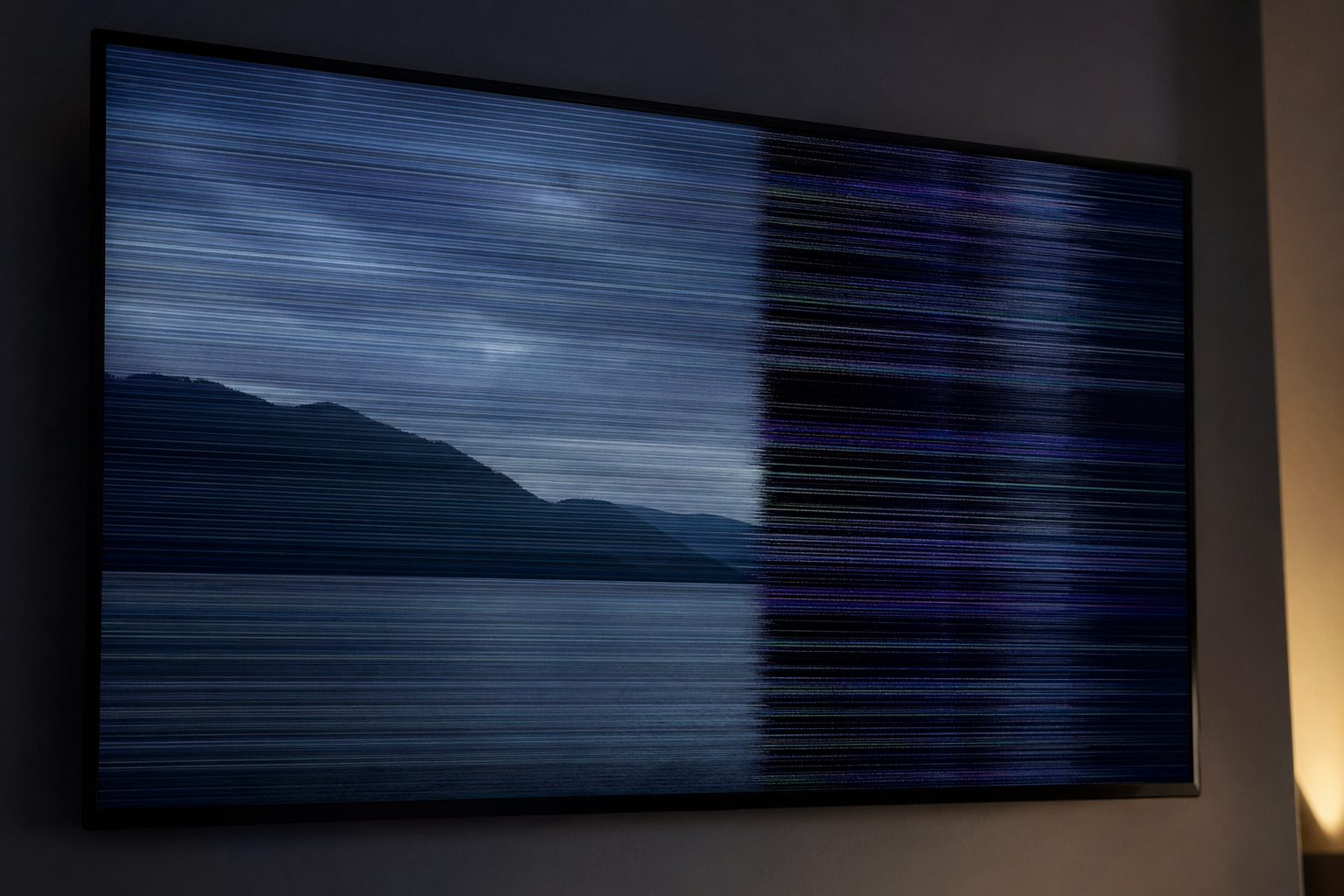
Picture Has Horizontal or Vertical Lines
Lines across the screen — whether horizontal, vertical, or a combination — are a symptom with several possible causes. The most important distinction is whether the lines are consistent and static, or whether they shift and change.
Static lines that don't move are usually caused by a fault on the T-Con board or, in more serious cases, by damage to the panel itself. A T-Con board fault is repairable; a damaged panel is generally not economical to fix on a standard-sized screen.
Lines that shift, flicker or change with movement can indicate a loose internal cable connection — which is one of the simplest and cheapest repairs possible.
Smart TV Functions Are Slow, Freezing or Not Working
A television that struggles to load apps, freezes during streaming, drops Wi-Fi connections or crashes back to the home screen is usually experiencing one of three things: a software issue, insufficient memory, or a failing main board.
Software issues are worth ruling out first — a factory reset and fresh software installation solve a surprising proportion of smart TV performance problems. If the issue persists after a reset, the problem is more likely hardware: the main board or eMMC storage chip may be failing.
It's also worth noting that smart TV platforms have finite support periods. A television that's 6–7 years old may simply have apps that have outgrown what the original hardware can support — in which case a replacement is genuinely the more practical option.
No Sound, But There Is Picture
Sound failure with an intact picture points most often to the audio amplifier board, the speaker connections, or — on many modern flat televisions — the speakers themselves, which are sometimes integrated into small modules that can fail independently.
Before assuming a hardware fault, run through the basics: check that the volume is not muted via the smart TV interface, check that external audio equipment (soundbars, HDMI ARC connections) isn't routing sound away from the internal speakers, and check that no audio output settings have been inadvertently changed.
If none of that resolves the issue, a repair is likely needed. Audio board repairs are generally at the cheaper end of the repair cost spectrum.
"Most of the faults I see day-to-day are perfectly repairable — even on sets that owners have already written off. A diagnosis takes twenty minutes and costs very little. It's almost always worth finding out before you buy a replacement."
Recognise Any of These Faults?
Use our directory to find a trusted TV repair engineer in your area. Most offer free or low-cost diagnostics — so you know exactly what you're dealing with before committing to a repair.
Find a TV Repair Engineer →