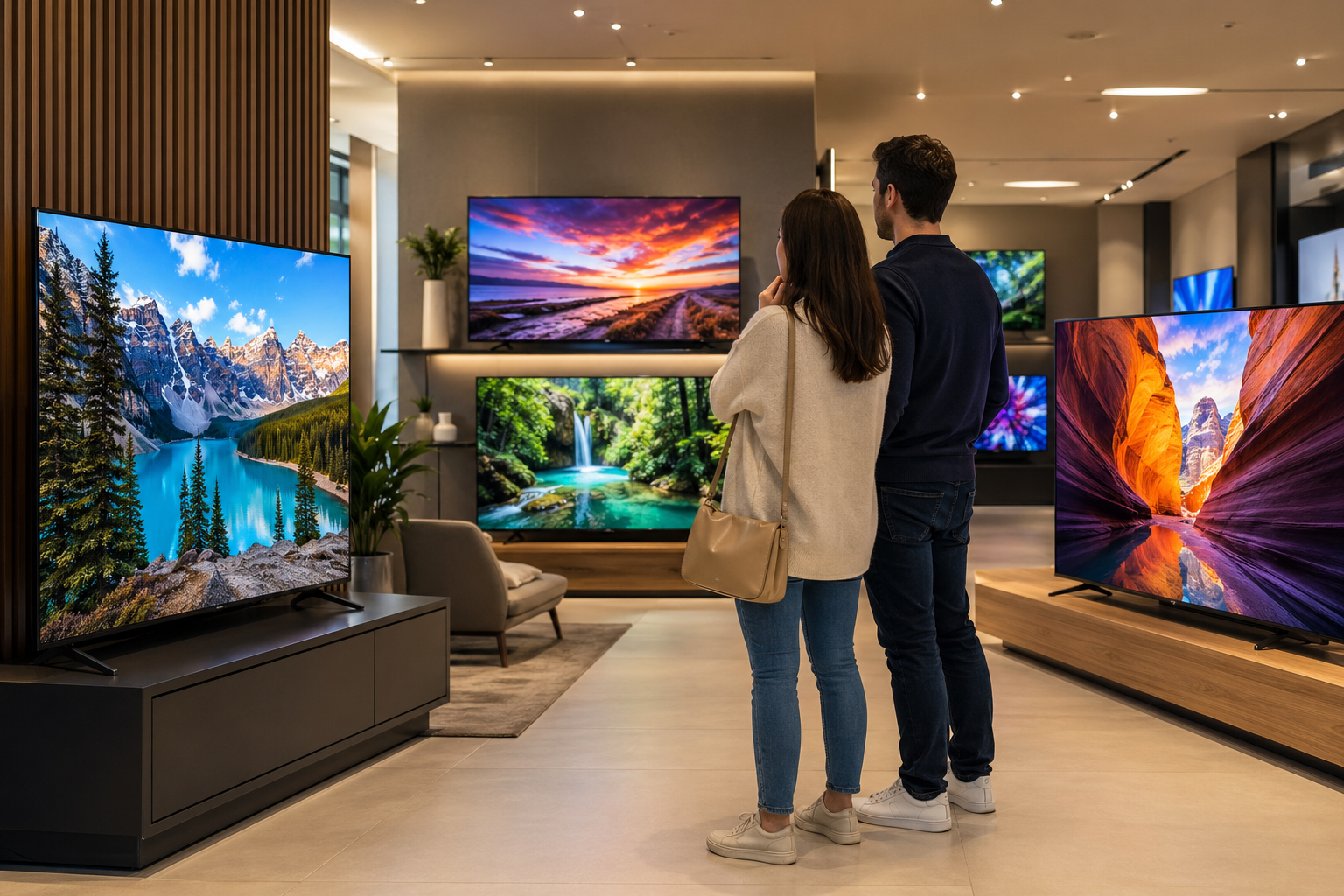
Buying a new television has never been more complicated — or more rewarding, if you know what you're looking for. The range of panels, resolutions, smart platforms and price points on offer in 2026 is remarkable. But most households don't need the most expensive option. What they need is the right option for how they actually live and watch.
Getting the Size Right
Screen size is the single biggest driver of satisfaction — or regret — after purchase. The general rule of thumb from television engineers and home-cinema specialists is the viewing distance formula: multiply the distance in feet between your sofa and your screen by ten to get the recommended screen size in inches. Sitting 8 feet away? A 75–80-inch screen will feel comfortable. Closer to 6 feet? 55–65 inches is your sweet spot.
Many households underestimate by one size tier and regret it. Very few go too large and wish they'd gone smaller. When in doubt, size up — and make sure the wall or cabinet can accommodate it.
| Viewing Distance | Recommended Size | Typical Room |
|---|---|---|
| 4–5 feet | 40–50 inches | Small bedroom, kitchen |
| 6–7 feet | 55–65 inches | Average living room |
| 8–10 feet | 70–85 inches | Large living room |
| 10+ feet | 85–100 inches | Open-plan, dedicated room |
Resolution: 4K, 8K, and What It Actually Means
In 2026, 4K (Ultra HD) is the clear standard for any television larger than 43 inches. It offers four times the pixel count of Full HD, and the difference is visible and meaningful — especially on larger screens or when streaming HDR content from Netflix, Disney+ or BBC iPlayer.
8K televisions exist and are impressive in showrooms, but there is still very little 8K content available to stream or broadcast in the UK. For most households, buying 8K in 2026 is spending significantly more for a marginal benefit you won't be able to see most of the time.
Panel Type: LED, OLED and QLED Explained
This is where most buyers get confused. The three main panel technologies each have genuine strengths and weaknesses.
- LED/LCD – The most affordable and widely available. Bright, reliable and long-lasting. Perfect for bright rooms. Less impressive in dark viewing environments due to limited contrast.
- OLED – Each pixel lights itself individually, producing perfect black levels and exceptional contrast. Outstanding for dark rooms and film viewing. Risk of burn-in on static images (sports scores, news tickers). More expensive, but the price gap has narrowed significantly.
- QLED – Samsung's quantum dot technology applied to an LED panel. Brighter than OLED and more resistant to burn-in, with excellent colour accuracy. Slightly less precise black levels than OLED. A strong choice for bright rooms.
Smart TV Features
Every television sold in the UK in 2026 is a smart TV. The question is which smart platform it runs. The main options are Google TV (used by Sony and others), Samsung Tizen, LG webOS, and Fire TV (Amazon). All offer access to Netflix, iPlayer, ITVX, Channel 4, Disney+ and Amazon Prime. The differences are in speed, interface and the quality of voice search.
One practical consideration that is often overlooked: smart TV platforms receive software updates for a finite period. A television bought today may stop receiving updates in four to six years, which could affect the performance of streaming apps. This is worth factoring into a buying decision for a set you expect to keep for a decade.
Budget Considerations
A good-quality 65-inch 4K LED television from a reputable manufacturer can be purchased for between £500 and £800 in 2026. A high-end 65-inch OLED from LG or Sony will cost £1,200–£2,500 depending on model and features. Mid-range QLED from Samsung sits comfortably between these figures at £700–£1,500.
"The budget sweet spot for most households is the mid-tier offering from a major brand. It offers 95% of the premium experience at 60% of the premium price — and genuine customer service if something goes wrong."
Buying for Longevity
A consideration that rarely features in buying guides but matters enormously: how repairable is the television you're buying? Televisions from major manufacturers — Samsung, LG, Sony, Panasonic — are far easier to source parts for and far more likely to have authorised repair centres in the UK. When your television develops a fault five years in, the difference between a repairable and an irreparable set can be significant.
Budget televisions from unfamiliar brands may be tempting on price, but spare parts are often unavailable or prohibitively expensive, and independent repair engineers may refuse to work on them entirely.
Already Have a TV That Needs Attention?
Before you buy a new television, it's worth checking whether your existing set can be repaired. A qualified engineer can often fix a fault for a fraction of replacement cost — usually with a warranty on the work.
Find a TV Repair Service →